Chapter 7
When one person has many things
At first, Gary just adds more columns.
Phone
Phone 2
Phone 3
It feels practical.
Until it doesn’t.
The list starts bending

Some customers have one number.
Some have two.
One has three.
Most of the new columns stay empty.
Gary scrolls sideways more than he wants to.
This reminds him of something.
He sighs.
Sam notices the familiar shape
Sam looks over Gary’s shoulder.
“You’ve seen this before,” he says.
Gary nods.
“It’s like the artist thing,” he says.
“But with people.”
Sam smiles.
“Exactly.”
The question isn’t how many — it’s where
Gary asks the question that’s been bothering him.
“But if I split this out,” he says,
“how does a phone number know who it belongs to?”
Sam doesn’t answer right away.
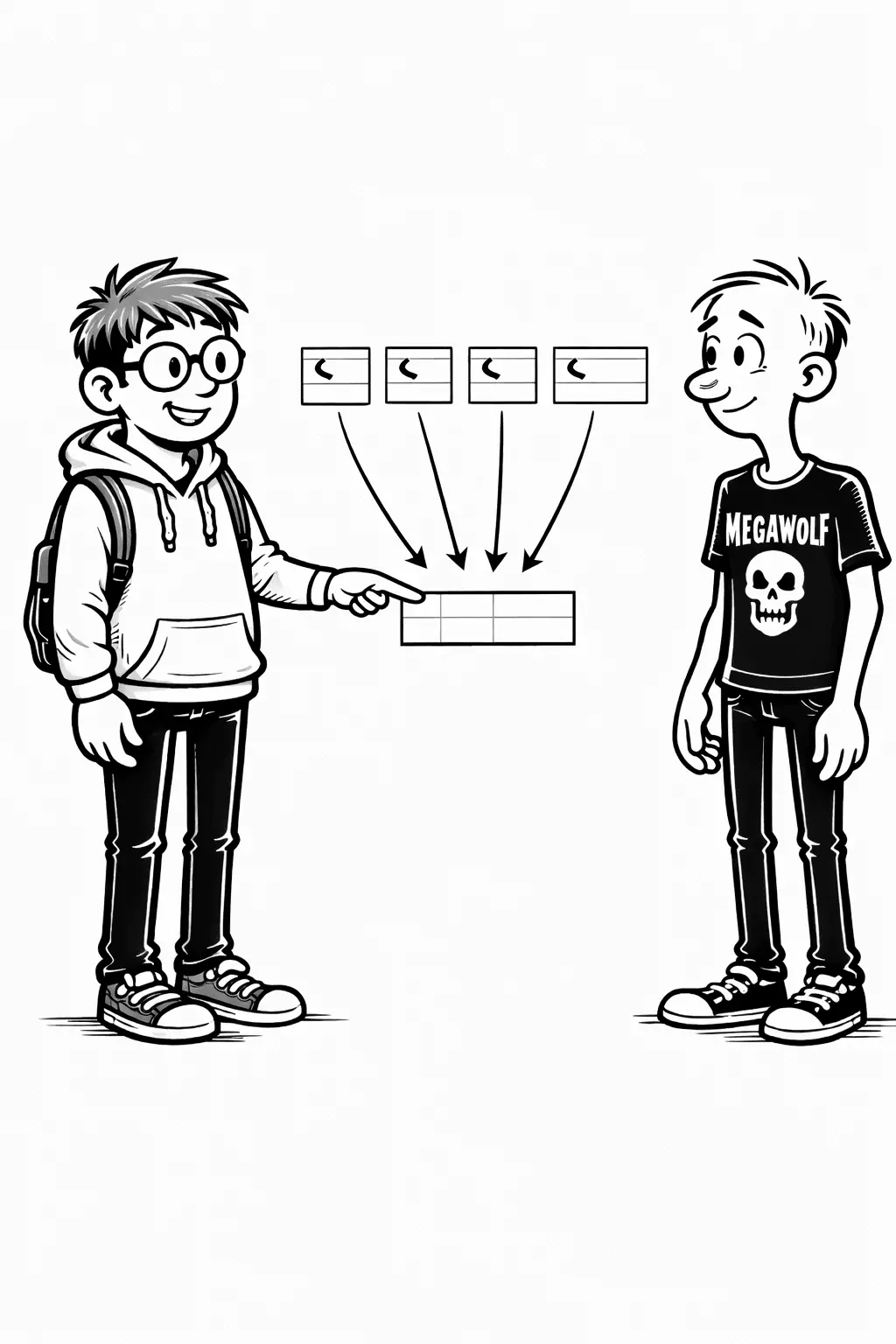
He points at the customer row.
“That,” he says, “is the important thing.”
Then he points at the phone numbers.
“They don’t point to each other,” he continues.
“They all point there.”
One stays. Many refer back.
Sam explains it slowly.
“The customer stays the same,” he says.
“The phone numbers come and go.”
Gary nods.
“So the connection lives with the phone numbers,” he says.
“Not with the customer.”
Sam nods back.
“One person,” he says.
“Many things.”
Gary pauses.
That feels right.
The structure settles

Gary restructures the list.
Each phone number gets its own row.
Each row points back to the same customer.
No duplication.
No guessing where to look.
Adding a number feels easy again.
So does removing one.
What Gary understands now
Gary doesn’t think in terms of techniques.
He thinks in terms of gravity.
Some things pull others toward them.
Some things only make sense when attached.
Once he sees that,
the structure almost designs itself.
Continue reading
In the next chapter, Gary takes a shortcut.
It works — at first.
But putting many meanings in one place
comes with a cost.