Patch integrations
Summary
Patch integrations happen when systems are connected through small fixes, field mappings, and custom scripts instead of shared structure and clear ownership.
The integration technically works.
Data moves.
APIs respond.
But the connection is fragile, difficult to understand, and hard to change.
Over time, the organization depends on connections that nobody fully trusts.
Touches lenses:
Integration, Information, Processing
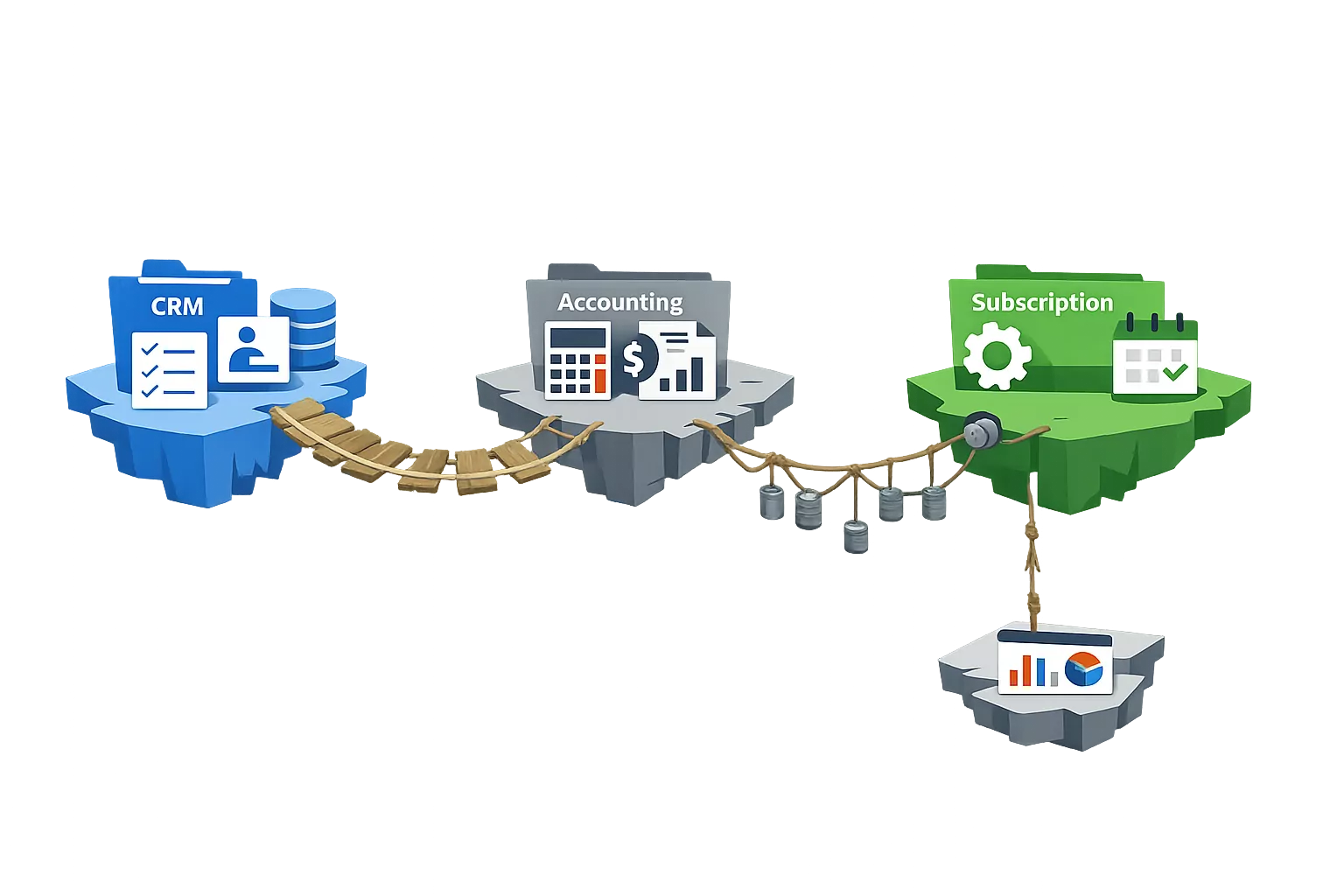
A simple example
Imagine a growing company using:
- A CRM
- An accounting system
- A subscription platform
- A reporting tool
At first, they export customer data from the CRM to accounting manually.
Later, someone creates a small script to sync customers nightly.
Then another script syncs invoice status back.
Later still, a webhook is added to update subscription state.
Each integration solves a real problem.
None of them are wrong.
But they were built independently.
After two years:
- Customer status is mapped three different ways
- Invoice states are translated using custom logic
- Some fields are duplicated “just in case”
- Nobody remembers why certain transformations exist
The systems are connected.
But not aligned.
This is patch integration.
Recognition
You may have patch integrations if:
- Integrations are described as “temporary” but never removed
- A change in one system breaks something unexpected elsewhere
- Field mappings are documented in spreadsheets instead of models
- The same value is transformed differently in different flows
- Only one developer understands how the integration works
There is no obvious failure.
But there is growing uncertainty.
What is really breaking
The problem is not that systems are connected.
The problem is how they are connected.
A healthy integration is based on:
- Clear ownership of concepts
- Explicit transformation rules
- Stable interfaces
- Documented boundaries
Patch integrations are based on:
- Field-to-field copying
- Conditional fixes
- Silent assumptions
- Local workarounds
Instead of aligning meaning, they translate symptoms.
Instead of modeling structure, they compensate for differences.
This creates hidden logic between systems.
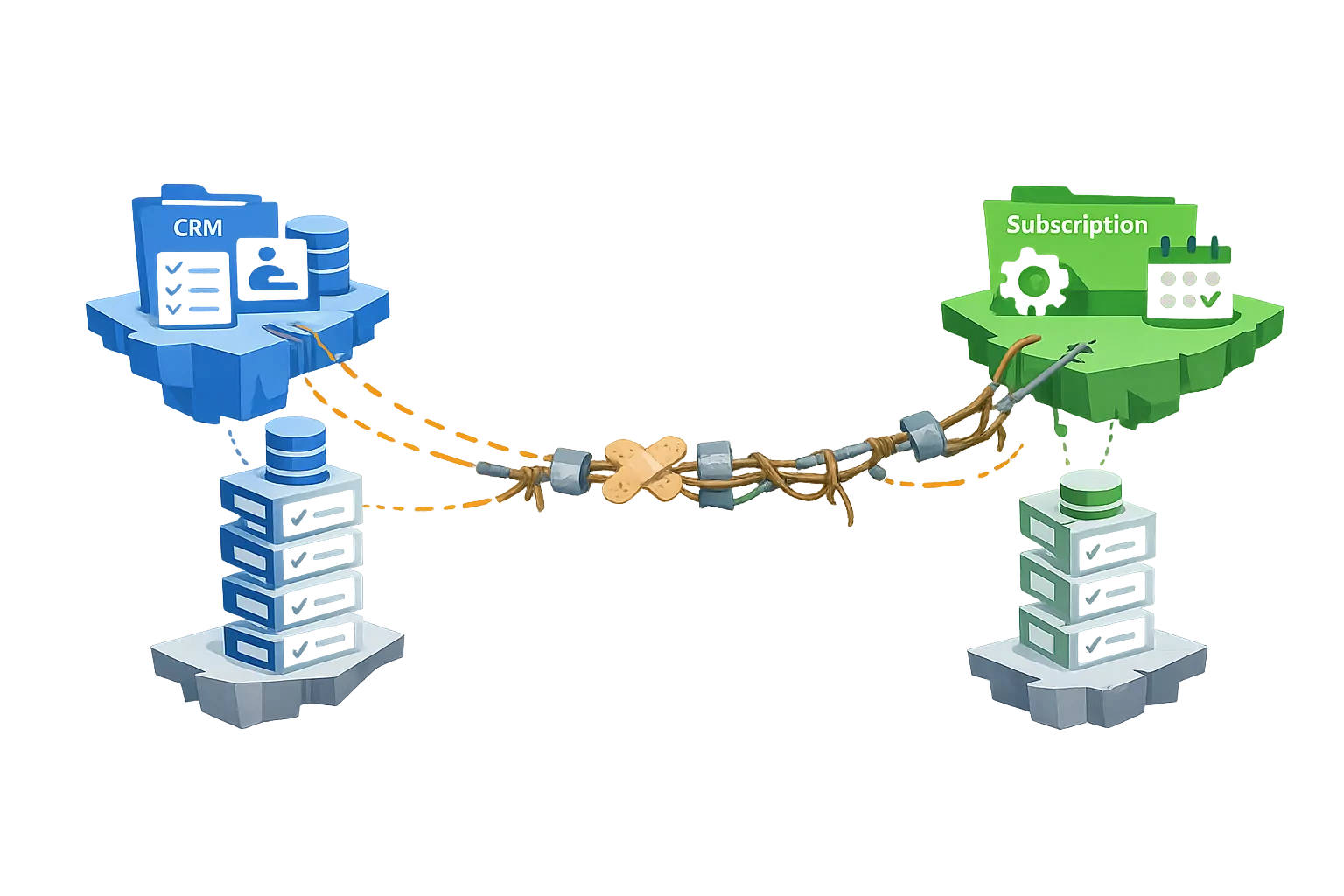
Why this happens
Patch integrations usually start with urgency.
A team says:
“We just need these two systems to talk.”
The fastest solution is often:
- Copy this field to that field
- Convert this status to that status
- Add a conditional rule
- Ignore edge cases for now
Later:
- The business changes
- Definitions evolve
- New states are introduced
- Additional systems are added
Instead of revisiting structure, more patches are added.
Each patch makes sense in isolation.
Together, they create complexity.
No single decision caused the problem.
It accumulated.
Why it is hard to see
Patch integrations rarely fail completely.
They fail partially.
For example:
- Most customers sync correctly, but a few do not
- Most invoices match, except refunds
- Most subscription states align, except edge cases
Because the majority works, the integration is considered stable.
The fragility appears only when:
- A new feature is introduced
- A field changes meaning
- A new system is connected
- Automation increases
At that point, hidden assumptions surface.
But by then, the structure is deeply embedded.
A second example: order lifecycle
Imagine an e-commerce company.
The webshop has these states:
- Cart
- Paid
- Shipped
- Returned
The accounting system has:
- Draft
- Posted
- Credited
Instead of modeling a shared order lifecycle, the company creates mappings:
- Paid → Posted
- Returned → Credited
- Shipped → (ignored)
Later, partial refunds are introduced.
The webshop handles them.
Accounting does not.
A patch is added:
- If refund < 100%, adjust invoice amount manually.
Then subscription renewals are added.
Another patch.
Soon:
- The order lifecycle exists in five places
- Each system holds a partial version
- Reporting requires reconciliation logic
The integration works.
But it is no longer structurally sound.
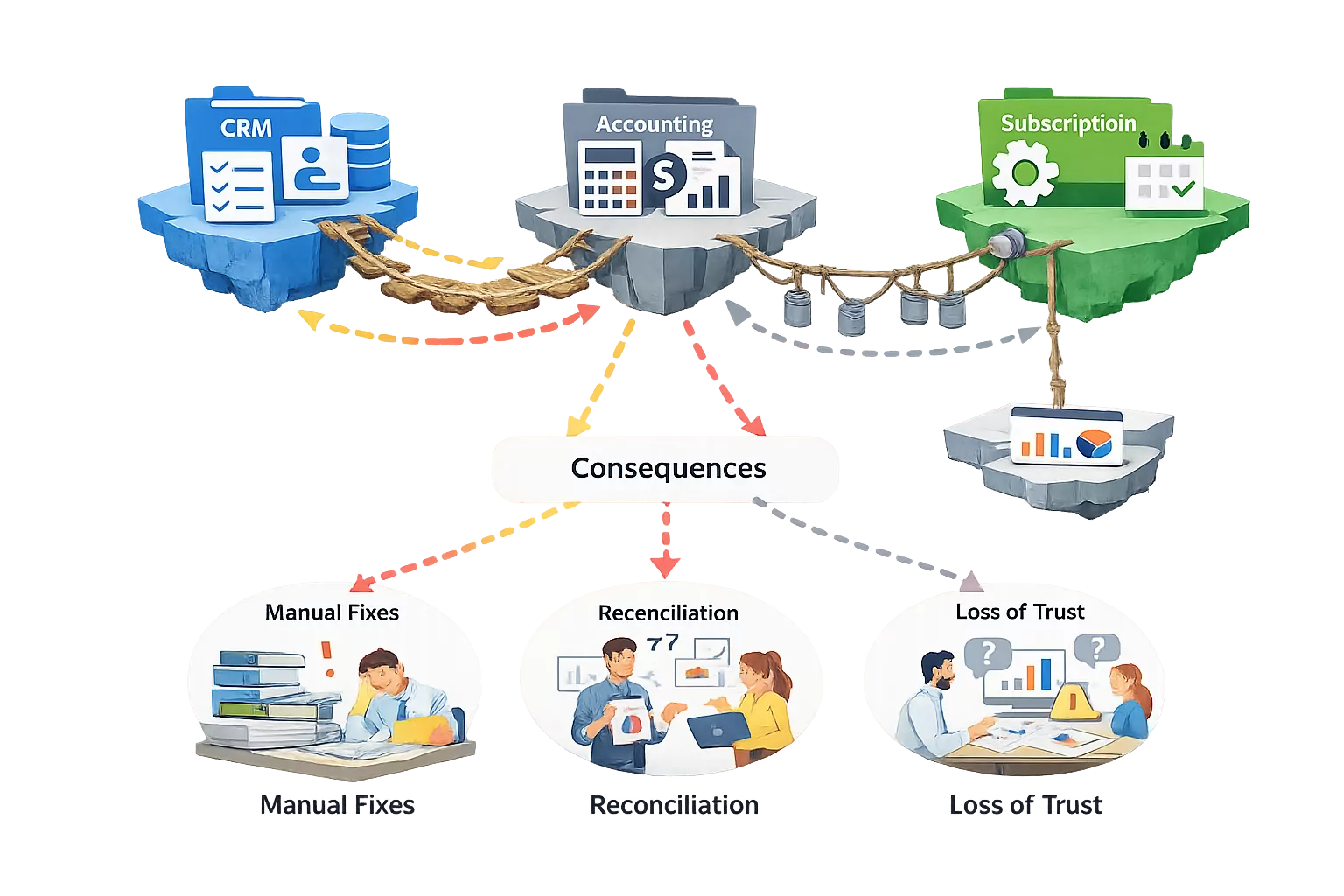
What it costs
Over time, patch integrations create:
- Increasing maintenance cost
- Fear of changing core systems
- Delayed feature releases
- Reconciliation work in Excel
- Reduced trust in automation
The business becomes cautious.
Teams hesitate to improve systems because:
“We’re not sure what else this will break.”
This slows growth.
How to test for it
Try these diagnostic questions:
- If a core field changes meaning, how many integrations must be updated?
- Can someone explain the full data flow without reading code?
- Are transformation rules documented in business terms?
- Does each concept have a clear system of record?
Another strong signal:
If we remove one integration script, do we fully understand the consequences?
If the answer is no, the integration landscape is likely patch-based.
Structural explanation
Patch integrations happen when alignment is replaced with translation.
There are two fundamentally different approaches to integration:
Structural alignment
- Define shared concepts
- Agree on lifecycle states
- Assign ownership
- Design stable interfaces
Patch translation
- Map fields directly
- Convert values locally
- Add conditionals
- Fix edge cases after failure
The first approach reduces long-term complexity.
The second reduces short-term friction.
Growing SMBs often start with translation because speed matters.
The problem appears when translation becomes the permanent model.
At that point, integration logic becomes its own invisible system.
Structural resolution
Fixing patch integrations does not mean replacing all systems.
It means restoring structure.
This typically requires:
- Identifying core concepts (customer, order, subscription, invoice)
- Choosing one authoritative owner per concept
- Making transformation rules explicit and documented
- Removing duplicate meaning from downstream systems
- Redesigning integrations around lifecycle alignment instead of field copying
The goal is not perfect uniformity.
The goal is explicit boundaries.
When boundaries are clear:
- Integrations become predictable
- Changes become manageable
- Reporting becomes trustworthy
Integration should reflect structure.
Not compensate for its absence.
In short
Patch integrations happen when:
- Systems are connected through fixes instead of shared models
- Meaning is translated instead of aligned
- Changes are handled locally instead of structurally
They often start as practical solutions.
But without structural correction, they accumulate into fragility.
Healthy integration is not about more connections.
It is about clearer boundaries.