Loss of trust in the system
Summary
Loss of trust in the system happens when people stop believing what their systems tell them.
The software runs.
Reports generate.
Dashboards update.
But decisions are no longer based on them.
Instead, people double-check numbers, export to Excel, or ask someone else to “verify” the result.
Trust has shifted away from the system and back to individuals.
Touches lenses:
Information, Processing, Integration
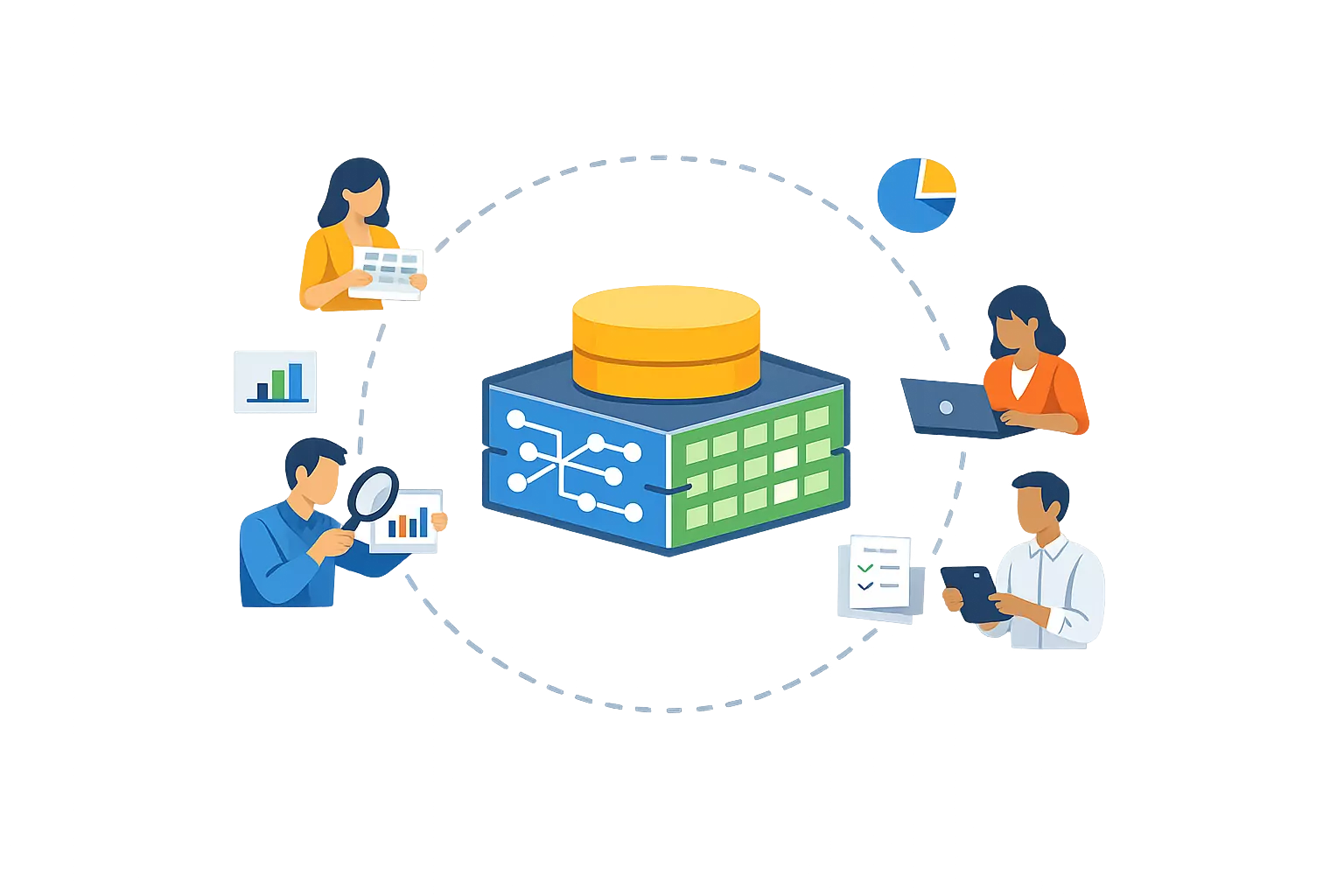
A common symptom
Many SMB leaders describe it like this:
- “The CRM says one thing, accounting says another.”
- “The dashboard looks good, but I don’t trust it.”
- “We always need to manually adjust the numbers.”
- “Before presenting to management, we double-check everything.”
Search queries often sound like:
- why do reports show different numbers
- dashboard totals inconsistent
- CRM and accounting numbers don’t match
These are not always technical failures.
Often, they are early signs of loss of trust.
What this pattern really is
Loss of trust is not primarily a data problem.
It is a structural credibility problem.
A system becomes trusted when:
- Its definitions are stable
- Its calculations are predictable
- Its integrations are transparent
- Its numbers can be explained
Trust erodes when:
- Definitions change silently
- Processing logic is unclear
- Multiple systems define the same concept differently
- Exceptions are handled manually
Over time, users learn:
“The system is usually right — except when it isn’t.”
That sentence is the beginning of distrust.
How trust erodes structurally
Trust rarely disappears overnight.
It degrades gradually.
A typical progression looks like this:
- A number looks strange.
- Someone finds a reasonable explanation.
- A manual adjustment is made.
- The explanation is not formalized.
- The next discrepancy requires another adjustment.
Each step seems small.
But structurally, something important has changed:
The system is no longer the final authority.
People become the correction layer.
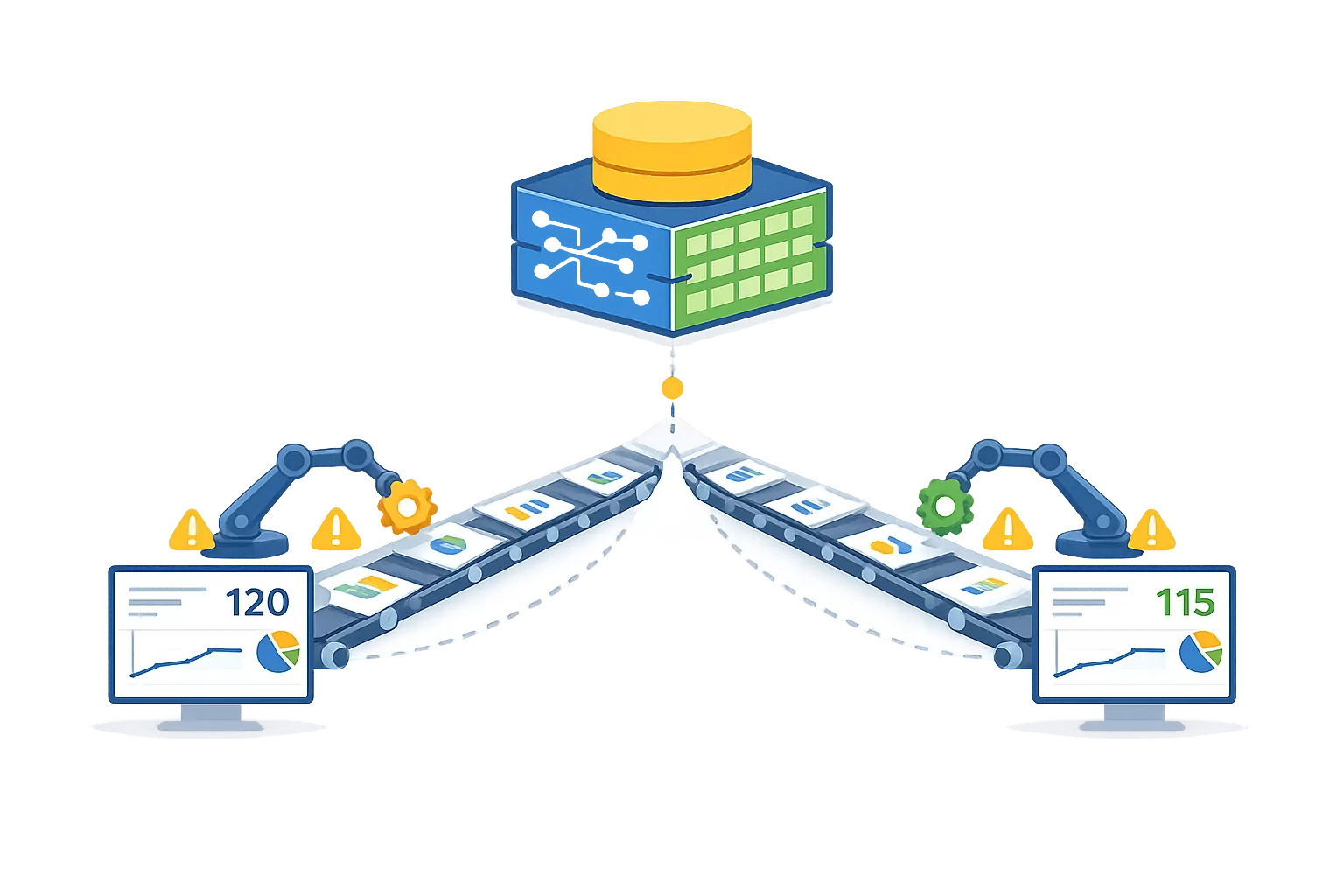
Example 1: Sales numbers
Imagine a company with:
- A CRM tracking deals
- An invoicing system tracking payments
- A BI dashboard summarizing revenue
The sales dashboard shows:
2.4M in revenue this quarter
Finance reports:
2.2M recognized revenue
Both are technically correct.
But the board sees two numbers for “revenue.”
Soon:
- Sales presents their own slide.
- Finance presents another.
- Leadership stops trusting the dashboard entirely.
The system did not crash.
But it stopped being a shared reference point.
Example 2: Inventory levels
A retail SMB tracks inventory in:
- The e-commerce platform
- The warehouse system
- A manual stock correction sheet
Occasionally, physical counts differ from system numbers.
Instead of investigating root causes, the team:
- Adjusts inventory manually
- Updates a spreadsheet “to be safe”
- Keeps notes outside the system
After a few cycles, employees say:
“The system stock is never fully correct.”
Even if discrepancies are small, trust declines.
And once trust declines, usage declines.
Why this happens
Loss of trust is often the downstream effect of other structural problems:
- Semantic drift — same field, different meaning
- Hidden processing logic — calculations not visible or documented
- Accumulation errors — values built over time without full traceability
- Integration gaps — asynchronous systems updating at different times
- Manual overrides — exceptions handled outside formal rules
Each issue alone may be manageable.
Together, they create uncertainty.
And uncertainty undermines authority.
Why it is hard to detect
Loss of trust does not appear in logs.
There is no error message.
Instead, you notice behavioral signals:
- People export data before meetings.
- Teams maintain shadow spreadsheets.
- Reports require verbal disclaimers.
- Numbers are presented with “approximately.”
These are social signals of structural weakness.
The system still functions technically.
But socially, it has lost authority.
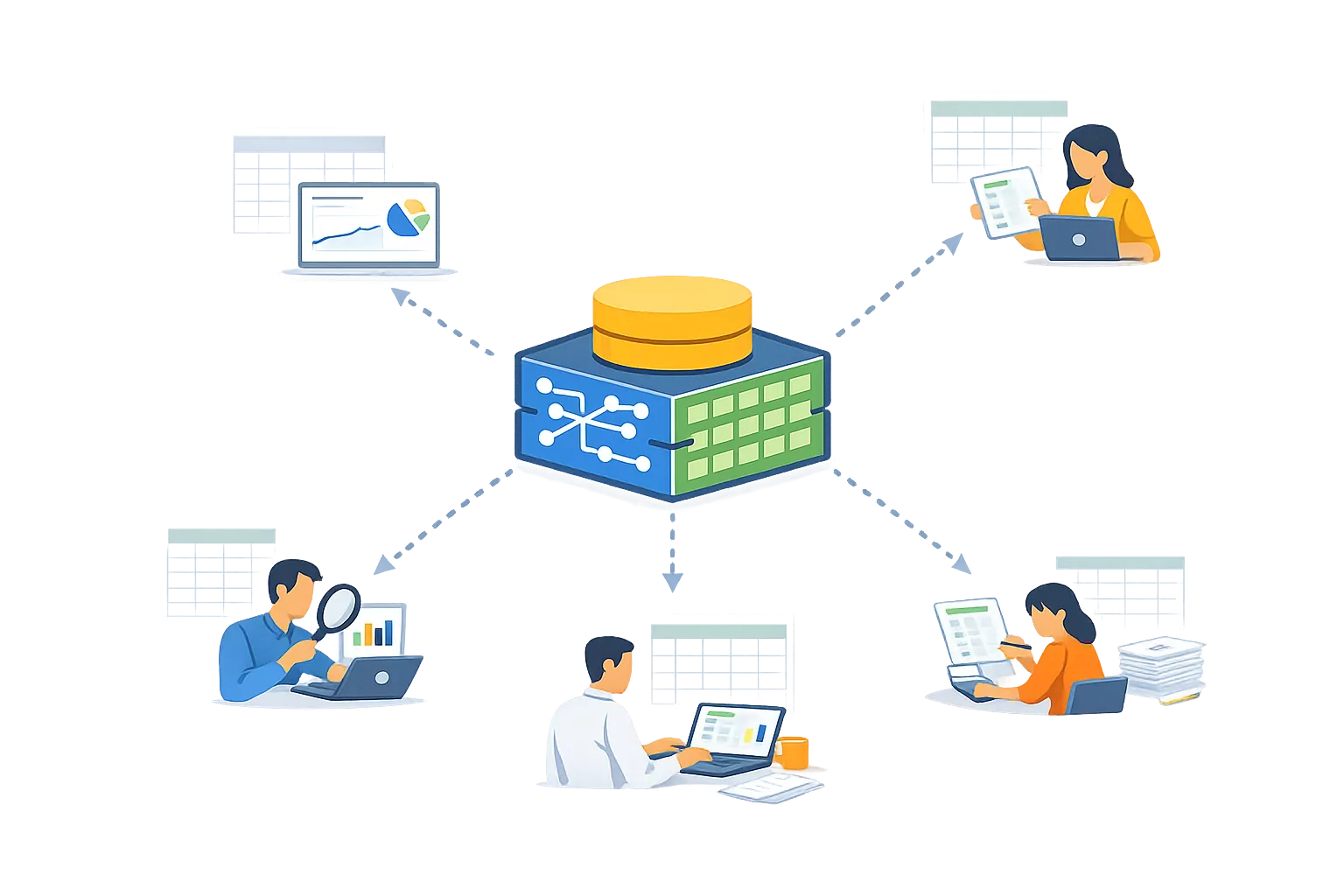
The real cost
When trust declines:
- Decisions slow down.
- Meetings focus on defending numbers.
- Automation initiatives stall.
- New dashboards are questioned immediately.
- Data-driven culture becomes fragile.
More importantly:
Strategic conversations shift from:
“What should we do?”
to:
“Which number is correct?”
That shift consumes time and energy.
For an SMB, that cost is significant.
Diagnostic tests
You can test for loss of trust using simple questions:
- Do different teams use different “final” reports?
- Are manual corrections common before presenting numbers?
- Does management ask for raw exports instead of dashboards?
- Can two systems disagree and both be considered valid?
- Are key metrics documented with precise definitions?
If multiple answers are “yes,” trust erosion is likely underway.
What rebuilding trust requires
Rebuilding trust is not about better visualization.
It is about structural clarity.
This usually requires:
1. Definition ownership
Key concepts must have:
- A clear definition
- A structural owner
- A single authoritative calculation
If “revenue” exists in three systems, one must be the reference definition.
Others must align or clearly differ.
2. Transparent processing
Accumulations, derived values, and state transitions must be explainable.
If a number cannot be traced back step-by-step, it will not be trusted.
Processing logic should be:
- Documented
- Predictable
- Consistent across contexts
3. Reduced manual correction
Every manual adjustment is a signal.
Instead of adjusting outputs, investigate causes:
- Why did the discrepancy occur?
- Is timing misaligned?
- Is the definition inconsistent?
- Is accumulation incomplete?
Fixing structure restores credibility.
Patching results weakens it further.
4. Explicit integration boundaries
If systems intentionally differ, that difference must be visible.
For example:
- “Operational revenue”
- “Recognized revenue”
- “Cash revenue”
Clarity preserves trust even when variation exists.
What rebuilding trust does not mean
It does not mean:
- Consolidating all systems into one
- Eliminating all discrepancies instantly
- Achieving mathematical perfection
Trust does not require perfection.
It requires:
- Consistency
- Explanation
- Stability
People can accept differences.
They cannot accept unexplained differences.
In short
Loss of trust in the system happens when:
- Systems technically work
- But people no longer rely on them
It is not a software crash.
It is a structural credibility failure.
When definitions are stable, processing is transparent, and integrations are explicit, systems regain authority.
When authority returns, decisions accelerate again.