Information exists but can’t be assembled
Summary
Many small and medium-sized businesses experience this situation:
- “We must have this information somewhere.”
- “The data exists, but we can’t get the full picture.”
- “Why is it so hard to combine these numbers?”
The problem is not missing data.
The problem is that the information exists in fragments that cannot be assembled into a coherent answer.
This pattern appears when structure prevents combination.
Touches lenses:
Information, Integration, Processing

A familiar business situation
Consider a company that wants to answer a simple question:
“What is the total profitability per customer?”
They have:
- Sales data in a CRM
- Invoices in an accounting system
- Support costs in a ticketing system
- Subscription renewals in another platform
All data exists.
Each system works correctly.
But when management tries to combine everything:
- Customer names are spelled differently
- IDs are not shared
- Some systems use company name, others use contact email
- Historical changes are not tracked the same way
The result is manual work.
Spreadsheets become the integration layer.
The information exists, but it cannot be reliably assembled.
Recognition
You may be facing this pattern if:
- Reports require manual exports from multiple systems
- Analysts spend time matching records instead of analyzing
- Different departments maintain their own “master lists”
- Questions that sound simple require days of data preparation
- You hear: “We can’t combine those systems”
There is no single broken component.
The difficulty appears when combining them.
What is structurally happening
Information assembly requires three things:
- Shared identity
- Compatible structure
- Compatible time logic
If any of these are missing, assembly becomes unreliable.
Shared identity means:
- The same real-world entity has a consistent identifier
Compatible structure means:
- Concepts are modeled in comparable ways
Compatible time logic means:
- Changes are recorded in a way that can be aligned historically
When systems are built independently, these conditions often drift apart.
The data still exists.
But the assembly path does not.

Example: customer identity
One system defines a customer as:
- A company record
Another defines a customer as:
- An individual contact
A third system defines a customer as:
- A billing account
All are valid.
But when someone asks:
“How many customers do we have?”
The answer depends on which identity model is used.
The problem is not that the data is wrong.
The problem is that identity is not aligned.
Without shared identity, assembly requires interpretation.
Interpretation introduces inconsistency.
Example: operational cost visibility
Imagine a company that wants to understand:
“Which services are truly profitable?”
Revenue is available in the accounting system.
Staff time is tracked in a separate tool.
Resource usage is logged in another system.
But:
- Time entries are not linked to invoice lines
- Resources are not connected to specific customers
- Project codes are optional and inconsistently used
All data points exist.
But there is no structural path connecting cost to revenue at the same level of detail.
As a result:
- Profitability is estimated
- Allocation rules are invented
- Confidence is low
The business moves forward with partial visibility.
Why this happens
This pattern usually emerges gradually.
It often starts with reasonable decisions:
- Different departments choose tools independently
- A system is introduced for a narrow purpose
- Integration is postponed “until later”
- Identifiers are added informally
Over time:
- Each system optimizes for its own task
- Structural alignment is not maintained
- New fields are added without cross-system coordination
The organization accumulates information without accumulating assembly structure.
The result is fragmentation.
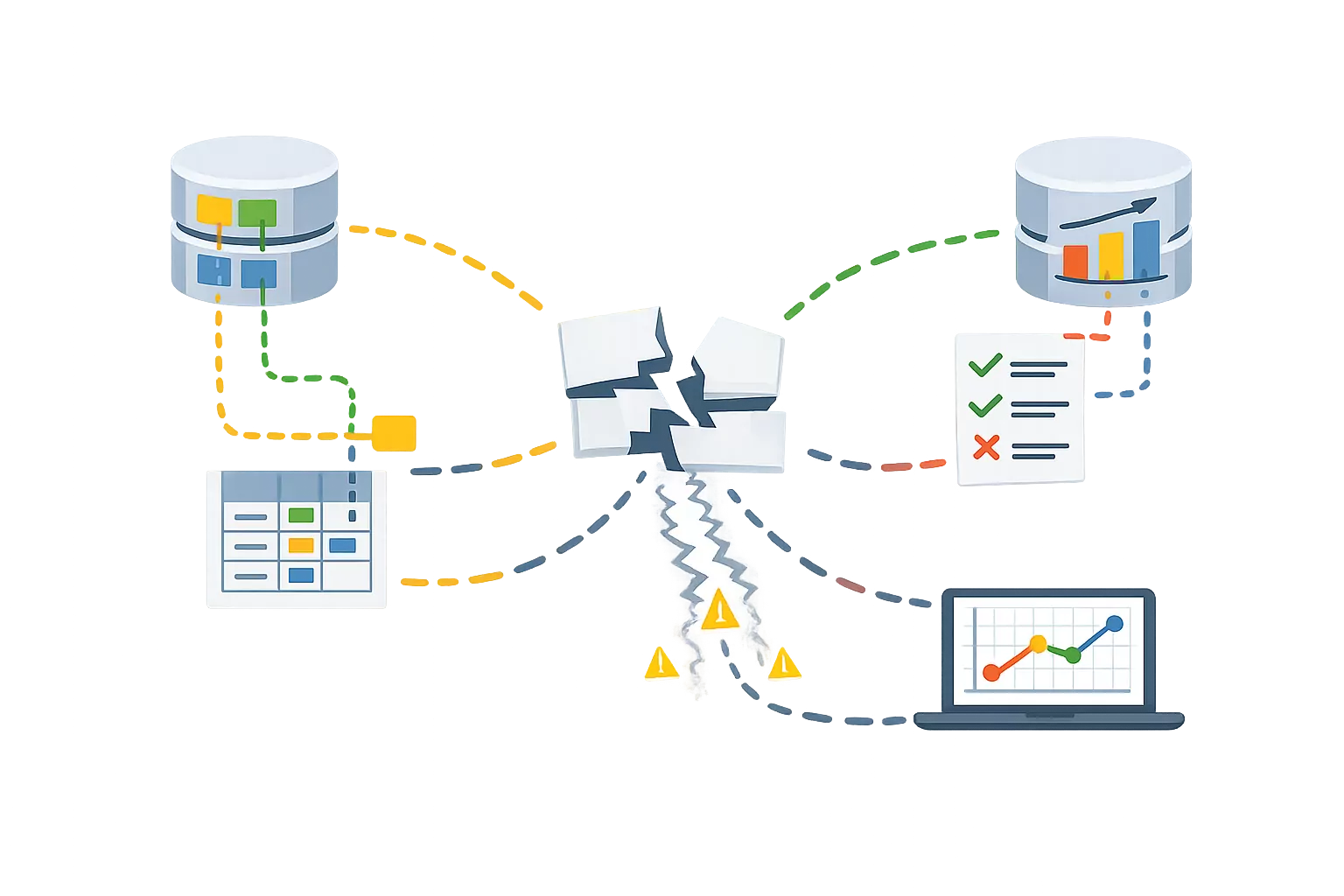
Why it is hard to detect
Each system looks complete.
Dashboards exist.
Reports run.
APIs respond.
The issue appears only when asking cross-system questions.
For example:
- “Customer lifetime value including support cost”
- “Revenue per product including refund impact”
- “Inventory value including reserved orders”
These questions require assembly across boundaries.
If the structure does not support that assembly, the answer cannot be produced reliably.
The absence of assembly often looks like a reporting limitation, not a structural issue.
What it costs
When information cannot be assembled:
- Decision cycles slow down
- Manual reconciliation becomes routine
- Strategic discussions rely on approximations
- Trust in numbers decreases
- Automation initiatives stall
Over time, this affects:
- Pricing decisions
- Resource allocation
- Investment planning
- Risk assessment
The organization may have plenty of data.
But it lacks structural coherence.
This creates hidden inefficiency.
Diagnostic tests
You can test for this pattern using simple structural questions.
Test 1: Identity alignment
If I take one real-world entity (e.g., a customer), can I trace it consistently across all relevant systems without interpretation?
If not, identity alignment is weak.
Test 2: Assembly path
Is there a defined, documented path that explains how two data points from different systems should be combined?
If the answer is “it depends,” assembly is fragile.
Test 3: Historical coherence
Can we reconstruct the state of a combined view at a specific point in time?
If historical data cannot be aligned across systems, assembly is incomplete.
Structural resolution
Solving this pattern does not necessarily require replacing systems.
It requires making assembly a first-class concern.
This may involve:
- Defining canonical identifiers
- Introducing a shared reference model
- Aligning core concepts explicitly
- Creating controlled integration layers
- Modeling time consistently across systems
The key shift is this:
Instead of asking whether data exists, ask whether it can be assembled structurally.
Information without assembly capacity is limited in value.
When assembly is supported by structure, cross-system questions become predictable rather than manual.
Reports become reproducible.
Trust increases.
In short
Information exists.
But existence alone is not enough.
For information to support decisions, it must be:
- Identifiable
- Structurally compatible
- Historically alignable
When those conditions are missing, the organization does not lack data.
It lacks assembly structure.
And without assembly structure, even correct data cannot produce reliable insight.