Understanding business systems
Why this knowledge space exists

This knowledge space exists because many business problems are misunderstood.
Not because people lack experience, effort, or good intentions — but because there is often no shared way to see and reason about business systems.
This is not only about understanding your own organization.
It is just as much about understanding what all business systems have in common, how they differ, and how they interact with each other.
The material here is written for business people, not for a technical audience.
No programming knowledge is required. The focus is on concepts, structure, and shared language — so discussions about systems, tools, and change can be grounded in understanding rather than assumptions.
Why understanding systems matters

Because many of the most important business decisions today are no longer about what to do — but about how things are structured.
When systems are poorly understood, discussions tend to split in two. Business conversations stay high-level and outcome-focused. Technical conversations become detailed and tool-specific. The gap between them grows, and important decisions end up being made without a shared picture of how things actually work.
Understanding systems gives you a business-level view of structure — independent of tools, vendors, or implementation details.
It allows you to:
- reason about how information, rules, and processes fit together, without needing technical expertise
- have meaningful conversations with technical teams, based on structure and intent rather than features and jargon
- spot risks and opportunities early, instead of discovering them only after changes have been made
- think about future growth, integrations, or constraints without falling into “that’s too technical” or “that’s someone else’s area”
- ask better questions when evaluating software, vendors, or platforms — and recognize when answers don’t address the real issue
This kind of understanding is especially valuable when change is involved: new tools, new partners, new regulations, or new ways of working. It helps you anticipate where friction is likely to appear, and where improvements will have the most impact.
You don’t need this perspective to run day-to-day operations.
You need it when you want to steer the system, not just react to it.
From overview to deeper understanding
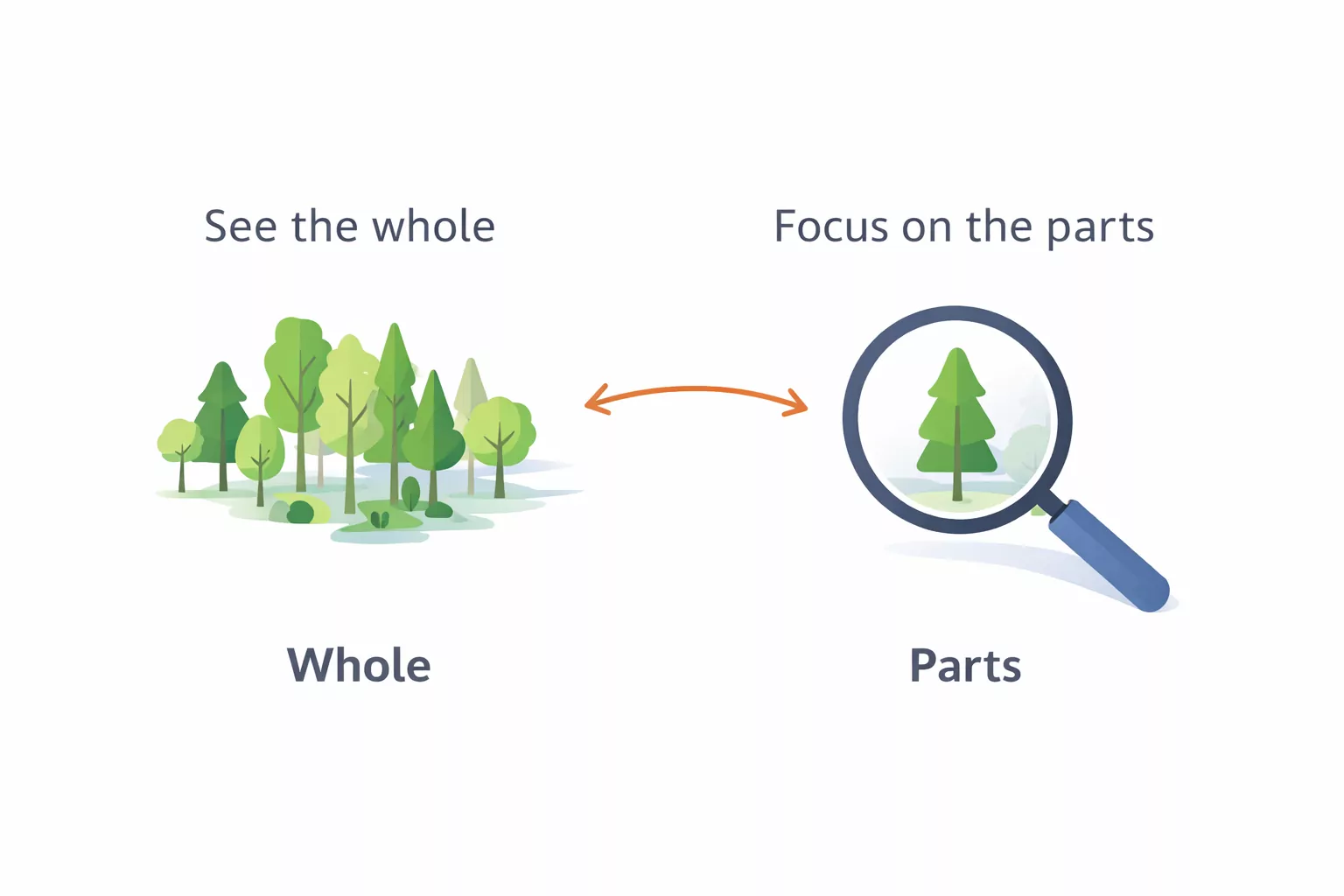
This article is the starting point for the entire knowledge space.
It introduces a shared way of looking at business systems — not by focusing on details, tools, or specific situations, but by establishing a clear overall picture. From here, the material gradually becomes more detailed and more specific.
The structure is intentional:
- it begins with what all business systems have in common
- then breaks that understanding into clearer areas and concepts
- and eventually goes deeper into specific aspects, patterns, and situations
Each level builds on the previous one. You are never expected to jump straight into details without context.
You can use this knowledge space in different ways. Some readers only need the high-level perspective to orient themselves and support discussions. Others will continue into the deeper articles when they want to understand a particular area, problem, or pattern more precisely.
What keeps all of this connected is a shared model.
The model acts as a common reference point, making sure that every concept, example, and deep dive fits into the same overall structure — so details never lose their connection with the whole.
Why we need a model

To reason about systems — especially across organizational boundaries — we need a model.
Without a model, conversations stay tied to specific situations:
“this tool doesn’t work”,
“that integration is fragile”,
“we can’t trust their data”,
“changing this will break something else”.
A model provides a stable frame of reference. It allows different systems to be discussed using the same language, even when the underlying tools and implementations are completely different.
This model is the backbone that the rest of the knowledge space is built around.
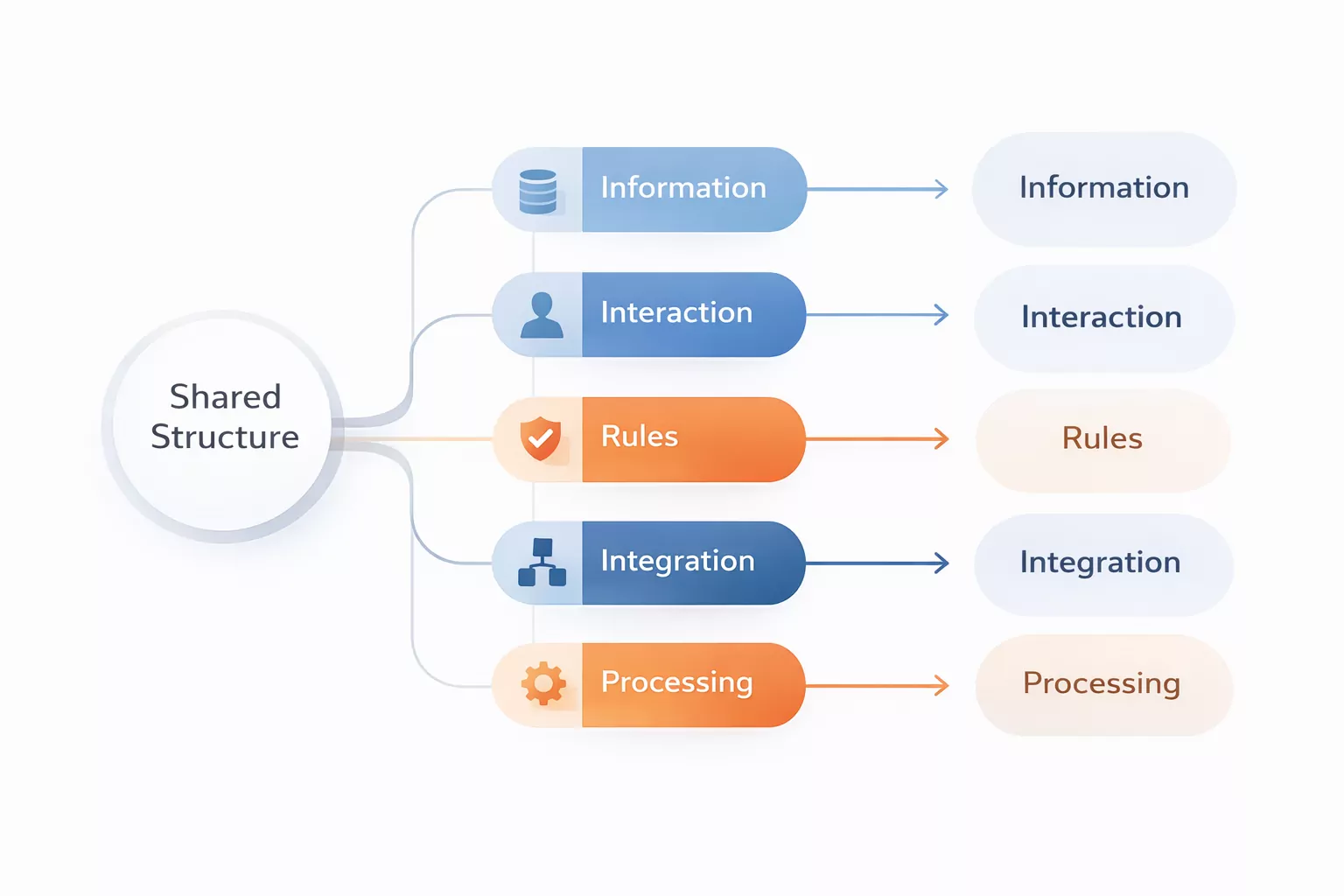
When business systems are viewed conceptually, the same structural elements appear everywhere. Any business system:
- manages information
- enables people to interact with that information
- operates under rules and constraints
- connects to other systems
- processes information as part of everyday work — creating it, updating it, and acting on it
These are not technical design choices.
They are fundamental properties of business systems.
The Five-Part Business System Model
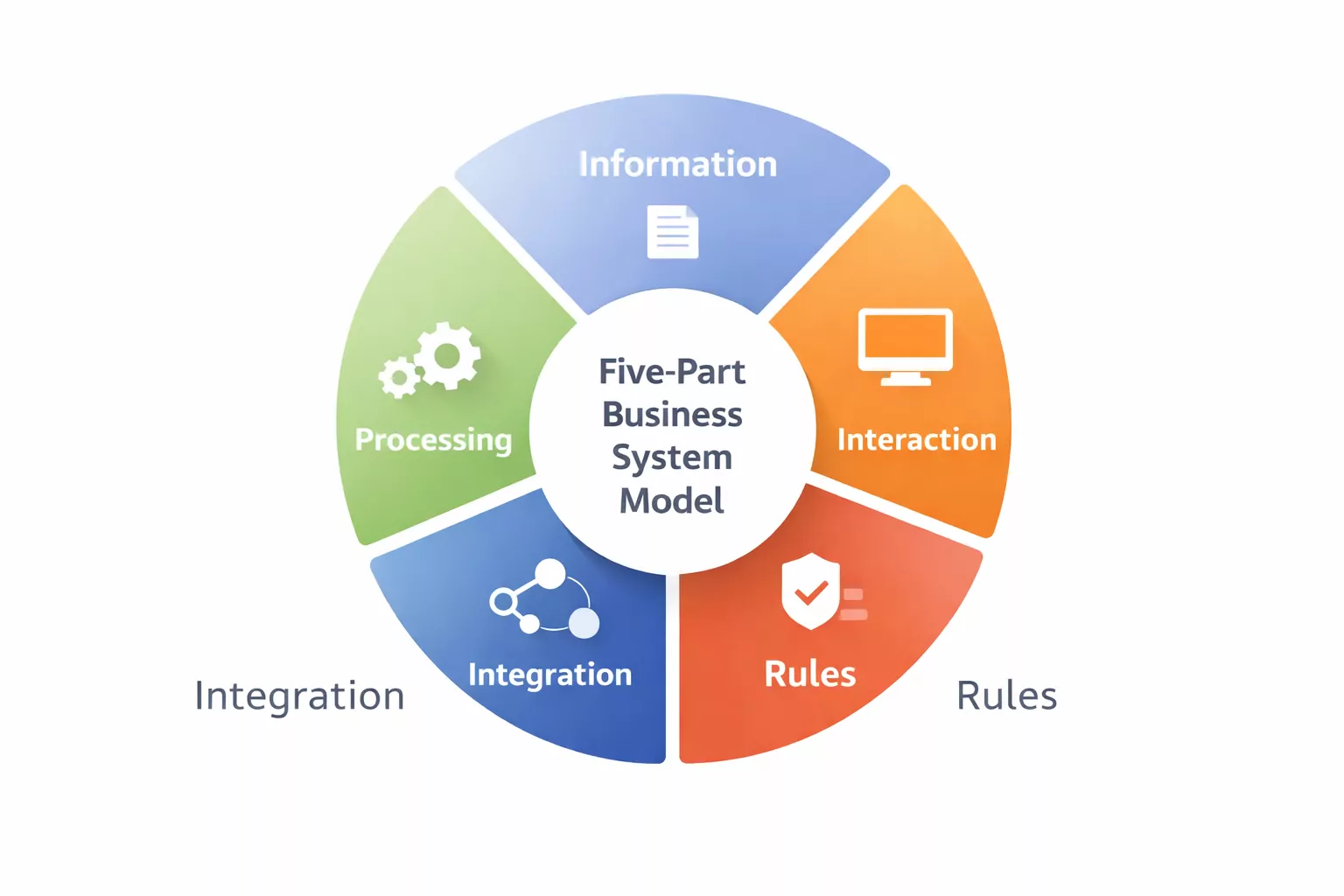
From this shared structure comes a general framework: the Five-Part Business System Model.
It describes five areas that exist in every business system:
-
Information
What the system knows, stores, and relies on -
Interaction
How people access, interpret, and work with that information -
Rules
What the system allows, restricts, or enforces -
Integration
How the system connects to other systems and stays aligned -
Processing
How the system works with information over time
Each area contains articles that help you recognize these structures across many different organizations — not just your own.
Common patterns and recurring pitfalls

In addition to the five areas, there is also a dedicated section focused on common system patterns and pitfalls that you can find under - patterns .
These articles describe recurring problems that appear both within individual systems and where systems meet. Examples include information that slowly changes meaning over time, different systems disagreeing about what is correct, important rules that exist outside the system, and connections that break when small changes are made.
Each pattern explains what is happening, why it occurs, and what can be done about it — always from a business perspective, without technical detail.